
Frequently Asked Questions


  • How much does this service cost?
    Dig Safe is a free service, funded solely by its utility members to promote public safety and avoid costly underground utility damage

  • Who should make the call to Dig Safe, the contractor or the homeowner?
    Although some state laws do not specify whether the property owner or contractor should notify Dig Safe, we recommend the contractor make the call. The contractor is usually more familiar with the information required to obtain a Dig Safe permit.

  • What utility companies are required to join Dig Safe?
    • Massachusetts:
      Gas, Electric, Telephone, Cable Television and Private Water Companies
      (water companies whose rates are regulated by the MA Department of Telecommunications & Energy)
    • Maine:
      Gas, Electric, Telephone, Telegraph and Cable Television
    • New Hampshire:
      Gas, Electric, Telephone, Cable Television and Public Water Companies
      (water companies whose rates are regulated by the N.H. Public Utilities Commission)
    • Rhode Island:
      Gas, Electric, Telephone, Cable Television and Public Water Companies
      (water companies whose rates are regulated by the R.I. Public Utilities Commission)
    • Vermont:
      Gas, Electric, Telephone and Cable Television
    • IMPORTANT
      Municipalities (cities and towns who own water, sewer and drainage facilities) are not required to join the Dig Safe system. It is your responsibility to notify any nonmember companies.

  • How much time in advance do I need to call?
    In Massachusetts, Maine and New Hampshire, state law requires a minimum notification of 72 business hours (3 business days), and in Vermont and Rhode Island, 48 business hours (2 business days.) This does not include weekends and legal holidays.

  • The law says I have to 'premark' before calling Dig Safe. What is premarking?
    State law requires all excavators to premark the area of excavation before notifying Dig Safe. Premarking is defined as marking out the scope of the proposed excavation area, using white stakes, paint or flags. Indicating exactly where the work will take place aids the utility locator in finding the area of upcoming excavation work, keeps operating costs down, and prevents excessive marking in areas where they are not needed. Click here for premarking guidelines.

  • Will private lines on my property be marked?
    Member utilities companies are responsible to mark only the facilities that they own or maintain. Private underground pipes and cables may not be owned or maintained by member utility companies, therefore they are unable to locate them. It is your responsibility to investigate if any privately owned utilities are in the area.
    Click here for a list of private utility locators.

  • I've damaged a line. Now what?
    If there is a possibility that the damage may pose a threat to the health and safety of the public, call 911 in order to dispatch local officials who will determine whether the community is in immediate danger. Next, according to state law, it is the responsibility of the excavator to notify the affected utility company directly after damage occurs. State law prohibits the contractor from attempting to repair the line, or backfilling before the line has been repaired by the utility company. Familiarize yourself with your local utility companies' safety procedures and protocol in the event of utility line disruption.

  • I need to dig very close to the markings. How deep are the underground lines?
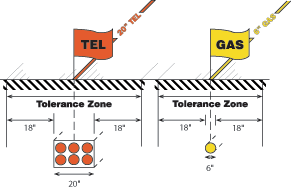
    The depth of underground facilities is variable, therefore state law requires excavators to use non-mechanical means when digging within 18" of a marked underground facility. The current depth of a facility might not be the same as when it was originally installed, due to soil erosion, grading and many other factors. To ensure the safety of excavators and avoid utility disruption, it makes sense to hand dig when working near an underground facility.

  • Should I get a Dig Safe permit if I'm in the designing stage of a job?
    A Dig Safe permit should only be processed if you intend to excavate within 30 days. If you need to know the location of underground facilities for planning purposes, please contact the member utilities directly. They will be happy to assist you with maps or drawings, or an on-site meeting.

  • I need proof of Dig Safe notification. How do I obtain a copy of my Dig Safe permit?
    Dig Safe records are retained for seven years, and stored in an off site archival facility. To retrieve records, we require:
    1. A written request to retrieve your Dig Safe permit, including the permit number(s). You may either mail, fax or e-mail this request to us. Contact Us
    2. A fee of $25.00 per ticket is assessed. Please make check payable to Dig Safe System, Inc.
    3. Dig Safe permits are private records, therefore we may only send copies to the company that originally obtained them. Insurance claims staff or a third party may obtain copies of Dig Safe permits, if we are provided with a release form from the excavator who originally notified Dig Safe. This form should express the permission of the excavator to release these documents to the third party and include the excavator's signature.
    4. The requested documents will be furnished 30 days upon receipt of the written request, check covering costs to retrieve each ticket, and release form (if necessary.)

Back to Top


Copyright ©2001-2002 Dig Safe System, Inc.
Site Designed By:New Wave Industries, Inc.